
Piazza Garibaldi, 1
Ingresso Via Zara, 1
63828 Campofilone (FM)
Dott.ssa Simonetta Ceccarelli
(+39) 335 59 32 708
info@bibliotecatittabernardini.com
More than 8,000 volumes catalogued and consultable in the Catalogue of the Sistema BiblioMarcheSud have been placed on open shelves in the library rooms. This is a multi-disciplinary heritage that from the numerous and valuable general works (historical, etymological, dialect and thematic dictionaries, encyclopaedias, etc.) gradually invests various fields, both humanistic, such as Latin and Greek, Italian and foreign literature, history, philosophy, art, geography, and scientific, in particular the natural sciences. Like most private libraries, however, the collections reflect the personalities, tastes and activities of those who created and increased them and whose memory we want to preserve as well as enhance their content. Let’s learn more about the three protagonists and their collections held in the Library.
As a passionate reader, the well-known baritone started book collections of various kinds, but the section dedicated to music and opera in particular remains predominant: in this rich section of over 1,200 volumes we find dictionaries, encyclopaedias, repertories and magazines as well as works on singing, composers, singers, conductors, librettists, and Italian and foreign theatres.
Part of the section is reserved for the human and artistic figure of Titta Ruffo, including the various editions of his autobiography.

As the son of the baritone, he has dedicated himself to enriching the collections he inherited from his father, and as a passionate bibliophile, he has devoted ample space in building his book collections to the history of books and related disciplines, in particular bibliology, librarianship, bibliography with rich thematic and biographical indexes, without neglecting book collecting and antiquarianism with notable collections of catalogues.
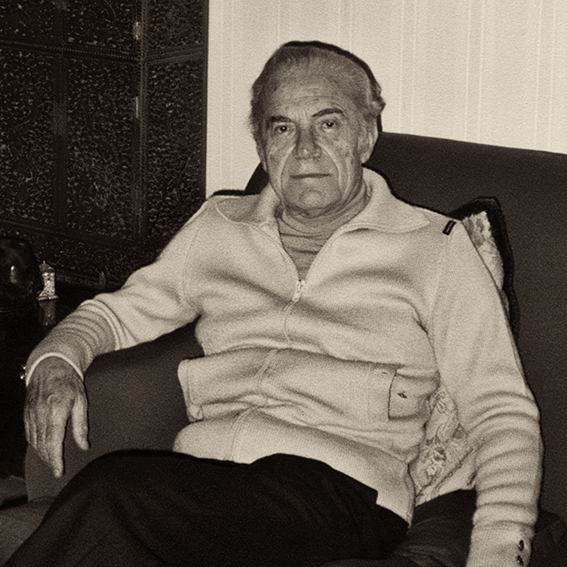
Grandson of the baritone, a publisher, writer, but above all a passionate seafarer, he turned his bibliographic interest to this subject, leaving behind a large and select collection that includes the history of navigation, Adriatic vessels and navies, nautical pleasure, marine antiques, and above all literature and tales of the sea, exploration, travel and adventure for adults and children.

Among the library collections we choose to include some collections, currently only available in the printed catalogue, which are certainly of great interest to scholars and bibliophiles.
The prestigious French publishing series, conceived in 1931 by a young publisher, Jacques Schiffrin, was taken over in 1933 by the Gallimard publishing house, considered one of the most important and influential houses in France. The aim of the collection is singular and innovative: to bring together, in pocket format (for that time) the masterpieces of world literature from Homer to the great classics to contemporary authors, with the contribution of prestigious editors, translators. Much appreciated by bibliophiles, La Pleiade’s collection is also distinguished by the elegance of its graphic layout and the care taken over the typographical composition: the books are printed on fine Indian paper (in French papier biblie, very thin and resistant), with Garamount typefaces, in a small format (17.5 cm), leather-bound, with titles and gold friezes on the spine. No less important is the philological care given to the prestige of the editors, the quality of the presentations and translations and the abundance of commentaries and critical apparatus.

There is a further special feature that distinguishes this impressive collection in that the colour of the binding of the volumes varies according to the era in which the author lived: antique green for ancient literature, purple for the Middle Ages, Corinth for the 16th century, Venetian red for 17th century literature, blue for the 18th century, emerald green for 19th century literature and finally Havana for the 20th century.
The complete list of titles held by the library can be found in the downloadable pdf list.
Also known as Budé, from the name of the Study Association dedicated to Guillaume Budé, humanist and bibliophile, it is a publishing series of Greek and Latin classics published by the French publishing house Les Belles Lettres, famous above all for its extensive collection of classical texts. It was founded in 1920 and since its foundation has become a reference series for its critical editions, presenting each classical text in its original language with its French translation, as well as an introduction and commentary on the work.
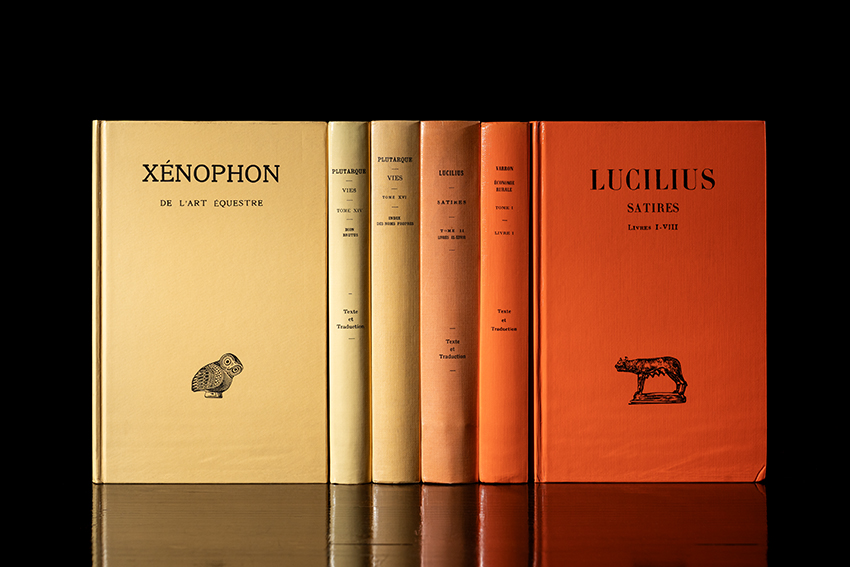
The format of the volumes has remained unchanged over time (20 cm) while the colour of the cover and the emblem that adorns it varies according to the series: the volumes published in the Greek series have a yellow cover with the stylised logo of an owl, while in the Latin series they have an orange/red cover with the logo of the Capitoline she-wolf.
The complete list of titles held by the Library can be found in the downloadable pdf list.
Inaugurated in 1856 by Gaspero Barbera, it was founded with the intention of fostering the spread of a national culture with the publication of classical works and literary masterpieces. The initiative was so successful right from the start that between 1856 and 1896, La Divina Commedia alone was printed fourteen times with a print run of 34,000 copies, and in no time at all it was a major publishing event as well as an economic one. The collection achieved even greater prestige when a name well known to Italian literature and, at that time, still a novice, began collaborating with Barbera’s publishing house: Giosuè Carducci. The 24° (10.5 cm) format was chosen for this collection, thus creating very small volumes with a weight ranging from a minimum of 100 g to a maximum of 325 g depending on the number of pages without neglecting elegance and accuracy.
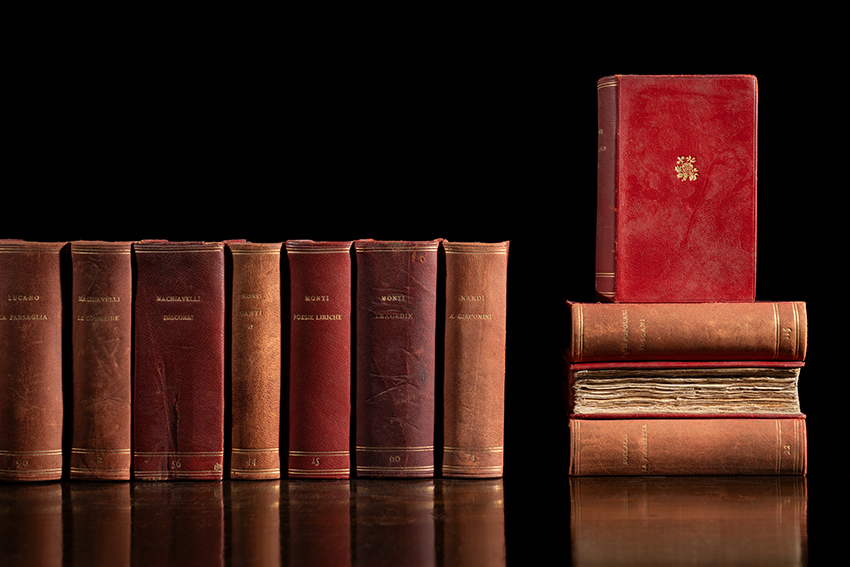
As for the choice of name, Gaspero Barbera wrote in his Memoirs of a Publisher: ‘Diamante is the name of one of the smallest typefaces and was therefore chosen with felicity to signify one of the smallest.
The complete list of titles owned by the Library can be found in the downloadable pdf list.